Azerbaijan National Academy of Sciences
The first website of Azerbaijan (1995)
 Elm TV
 Photo
 Video

- A-
- A
- A+
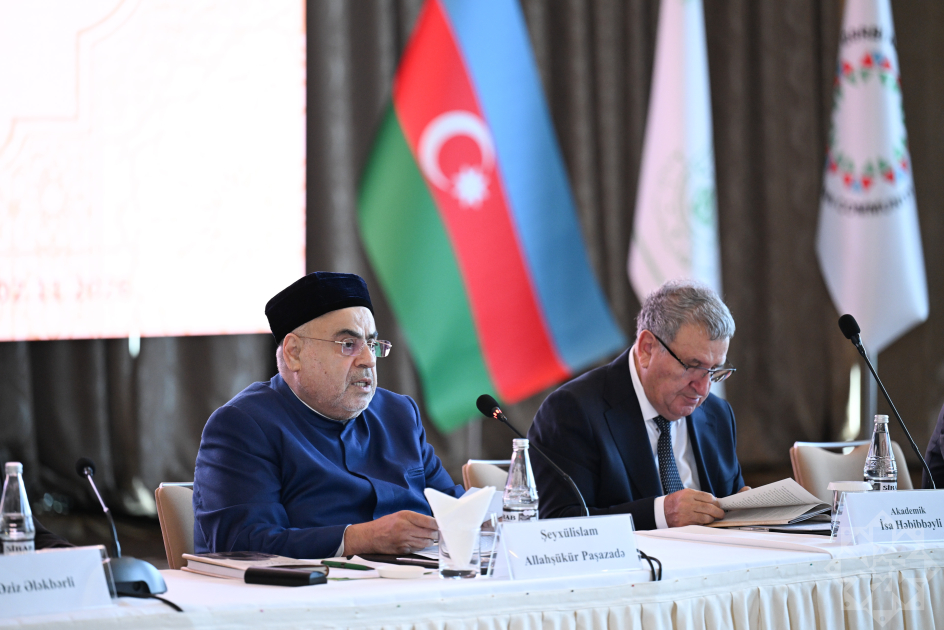
Academician Isa Habibbeyli: “The Textbook ‘Sustainable Development Policy’ Is an Important Contribution to the Scientific Community”
“The textbook Sustainable Development Policy is the result of the need arising from the processes taking place in our country in the field of sustainable development and the results achieved. The book is innovative in terms of its structure, content, objectives, and underlying concept, and is of considerable importance to the scientific community.”
President of the Azerbaijan National Academy of Sciences (ANAS), Academician Isa Habibbeyli, made these remarks at the presentation of the textbook Sustainable Development Policy.
The academician noted that, in Soviet society, the stages of societal development were explained on the basis of Marxist or socialist models. Following the dissolution of the USSR and the collapse of the socialist system, this approach also lost its relevance. Under these circumstances, developing a classification reflecting new stages in global development and historical processes became one of the tasks facing scientific and public thought.
“The presentation of a new classification of the stages of societal development in the post-Soviet period in the textbook Sustainable Development Policy represents an important scientific innovation. The book classifies societal development into three stages: the pre-industrial period, the industrial era, and the post-industrial stage. This approach reflects both global realities and the specific characteristics of our country’s development.
“The textbook also introduces new approaches to the Industrial Revolutions. In discussing the First Industrial Revolution, it highlights mechanical production alongside steam power, which formed its technological foundation. Regarding the Second Industrial Revolution, it emphasizes the emergence of new means of transport and communication alongside the use of electricity. These perspectives make it possible to understand the nature of these processes more fully. The book also clarifies the classification of the Third and Fourth Industrial Revolutions through analysis.
“One of the textbook’s important innovations is its scientific analysis of the concept of ecocivilization. This approach is particularly significant in light of the new opportunities created by Azerbaijan’s ‘Solidarity for a Green World’ initiative and major international events such as COP29. The concept of inclusive development is also explained clearly and systematically in the book, where it is presented as a policy of social equality and justice.
“Furthermore, the textbook’s significance is enhanced by its scientific interpretation of new concepts such as development without a future, development without excess, and the ecological footprint,” Isa Habibbeyli added.
Translation by Gulhane Aghayeva, Department of Public Relations, Press, and Information, Presidium of ANAS.
© All rights reserved. When using these materials, reference to www.science.gov.az is required.
Similar News


Links