Azerbaijan National Academy of Sciences
The first website of Azerbaijan (1995)
 Elm TV
 Photo
Photo
 Video
Video
- A-
- A
- A+
Unique Discovery at Alisha Fortress: Medieval Ceramic Vessel Examined by CT Scan for the First Time
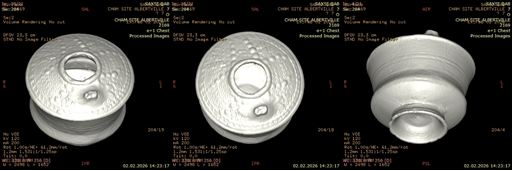
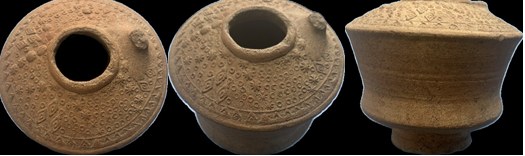
A scientific article authored by Mikayil Mustafayev, PhD in History and Head of the “Registration and паспортизация of Archaeological Monuments” Department at the Institute of Archaeology and Anthropology of ANAS, has been published in the Scopus-indexed journal Archaeology of Kazakhstan.
The article is dedicated to a rare ceramic vessel discovered during the 2025 excavations at Alisha Fortress in the Astara district.
The main subject of the study is a clay vessel dating back to the 11th–13th centuries (Seljuk period), featuring stamped geometric ornaments. This find is of particular importance not only for local archaeological material but also for the study of the medieval material culture of the South Caucasus as a whole.
One of the most remarkable features of the vessel is the presence of nine distinct stamped geometric motifs. These motifs—circles, rhombuses, star-shaped compositions, and linear ornaments—belong to the widely распространённой artistic tradition of the Seljuk period. However, their arrangement on the vessel is not systematic (in the form of a frieze), but rather free and non-repetitive, making this example unique. This characteristic suggests that the vessel was produced not in large manufacturing centers but in a local workshop.
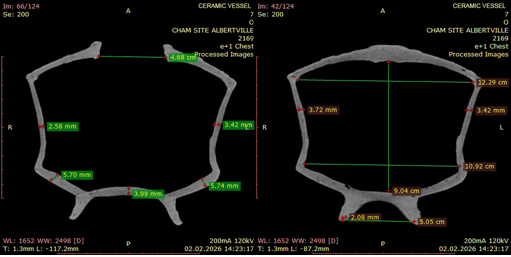
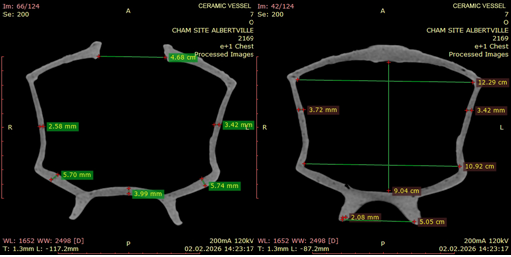
One of the key innovations of the research is that this ceramic vessel was analyzed for the first time using computed tomography (CT). This non-destructive method is rarely applied in archaeology and allows researchers to study the internal structure of an artifact without damaging its physical integrity.
The CT analysis revealed that:
- The wall thickness of the vessel varies across different sections (from 2.0 mm to 5.7 mm),
- This irregularity confirms that it was handmade,
- The vessel was formed in multiple stages rather than in a single process,
- Internal joining lines and structural features were clearly observed.
These findings indicate that the vessel is not a product of mass production but rather an everyday object crafted by local artisans. At the same time, the data obtained through CT technology has revealed new scientific facts that cannot be identified through traditional visual observation.
Comparative analyses show that the artistic and technological features of this vessel resonate with ceramic traditions of Azerbaijani cities such as Shamakhi, Shabran, and Beylagan, as well as Eastern centers like Khwarezm and Khorasan. In addition, comparisons with ceramics from Saraychik of the Golden Horde period also demonstrate long-term technological continuity.
The research results provide new scientific insights into the development of local craftsmanship traditions, production technologies, and decorative styles in medieval Azerbaijan. Future research at Alisha Fortress is expected to yield broader results in this field.
This study is considered an important step in Azerbaijani archaeology both in terms of introducing new material into scientific circulation and applying modern technologies.
Translation by Gulhane Aghayeva, Department of Public Relations, Press, and Information, Presidium of ANAS.
© All rights reserved. Reference to www.science.gov.az is required when using materials from this site.
Similar News


Links