Azerbaijan National Academy of Sciences
The first website of Azerbaijan (1995)
 Elm TV
 Photo
Photo
 Video
Video
- A-
- A
- A+
Archaeological Investigations at the Kharkhar Necropolis
The study of the material cultural heritage of Caucasian Albania is one of the most topical areas of Azerbaijani archaeology. Significant achievements have been made in this field in recent years. Particular emphasis should be placed on the investigation of burial monuments of Caucasian Albania dating to Antiquity and the Early Middle Ages. To date, jar burials, wooden box graves, stone box graves, and catacomb graves belonging to the Albanians have been excavated and studied in the territory of Azerbaijan.
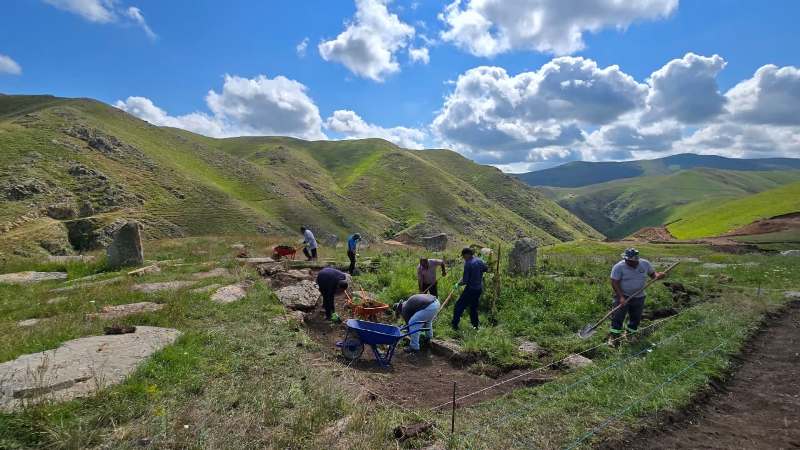
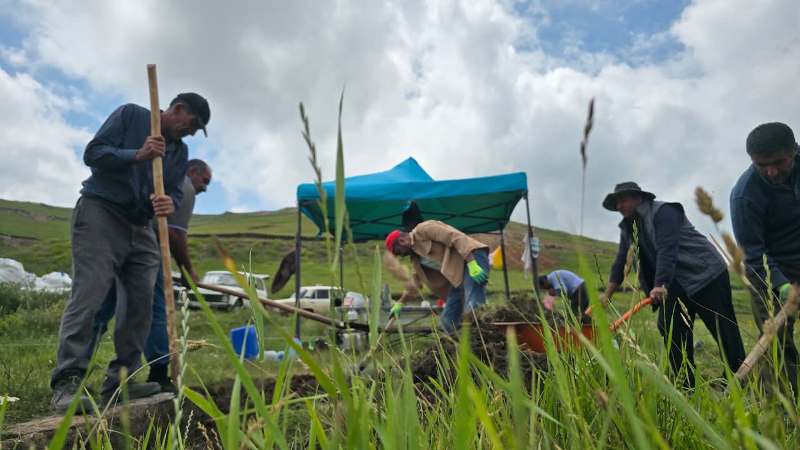
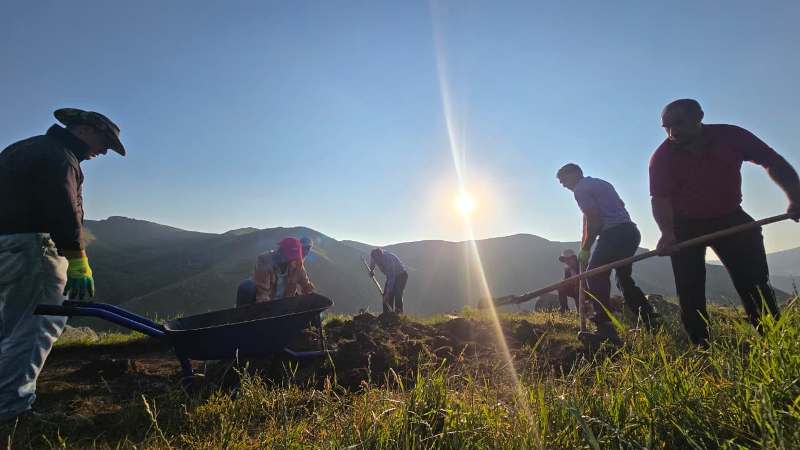
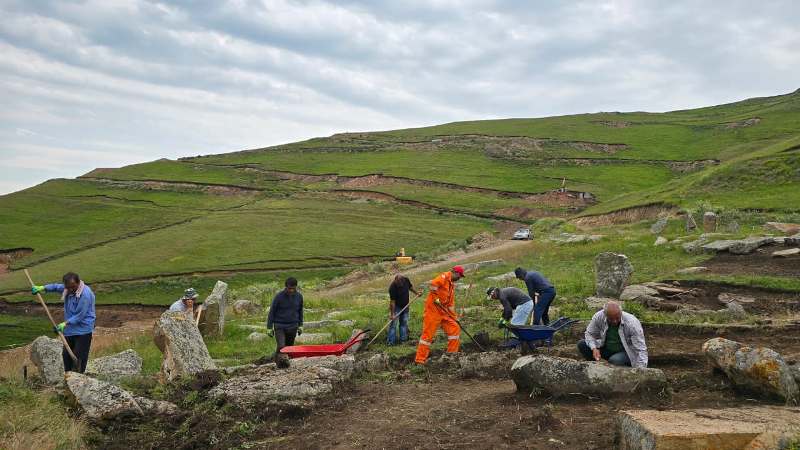
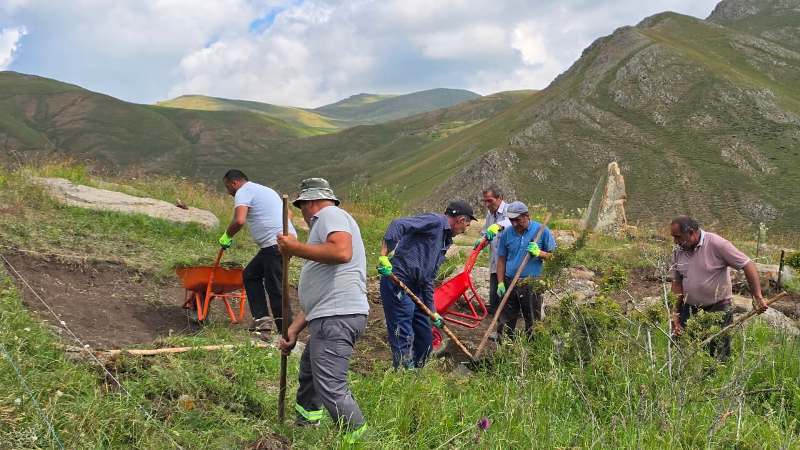
In this regard, the archaeological excavations conducted by the Institute of Archaeology and Anthropology of ANAS at the Kharkhar necropolis in the Gadabay District constitute a vivid example of serious scientific research. Pursuant to a joint agreement concluded between the Institute and the Azerbaijan International Mining Company (AIMC), archaeological excavations have been launched at the eponymous necropolis located in Kharkhar village of the Gadabay District. The Kharkhar team of the Gadabay Archaeological Expedition, comprising archaeologists of the Institute of Archaeology and Anthropology of ANAS, researchers specializing in Albanian heritage, anthropologists, ethnographers, conservator-restorers, artists, and other specialists, is operating at the necropolis. The expedition is headed by Shamil Najafov, Leading Researcher of the Institute of Archaeology and Anthropology of ANAS, PhD in History, Associate Professor.
The location of the Kharkhar necropolis was first identified in 2012 by the late archaeologist Goshgar Goshgarli during the registration of archaeological monuments of the Albanian period in the Shamkir and Gadabay districts, on the basis of information provided by local residents. A preliminary archaeological survey of the area was carried out, observations were made, and the characteristics of the monument were determined. The first comprehensive study of the necropolis based on archaeological reconnaissance was conducted in 2023 by Tukezban Goyushova, Head of the Gadabay Archaeological Expedition. The boundaries of the necropolis were determined, some of the graves were photographed, the perimeter coordinates of the site were recorded, and the collected information was included in the author’s scientific report.
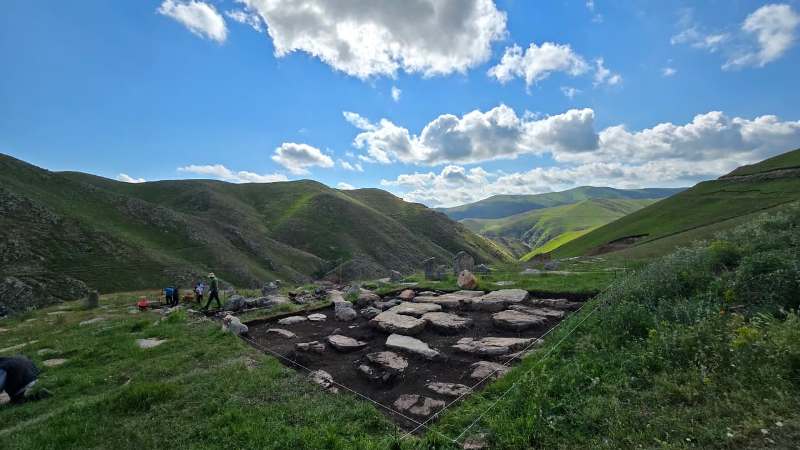
The Kharkhar necropolis is located in Kharkhar village of the Gadabay District, on the elevated left bank of a small mountain tributary of the Kharkharchay River, on a flat, gently sloping hill descending from a high mountain peak toward the river valley.
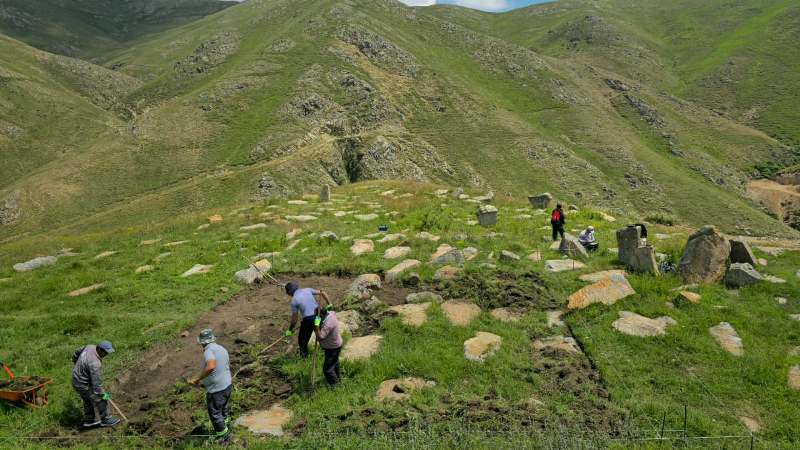
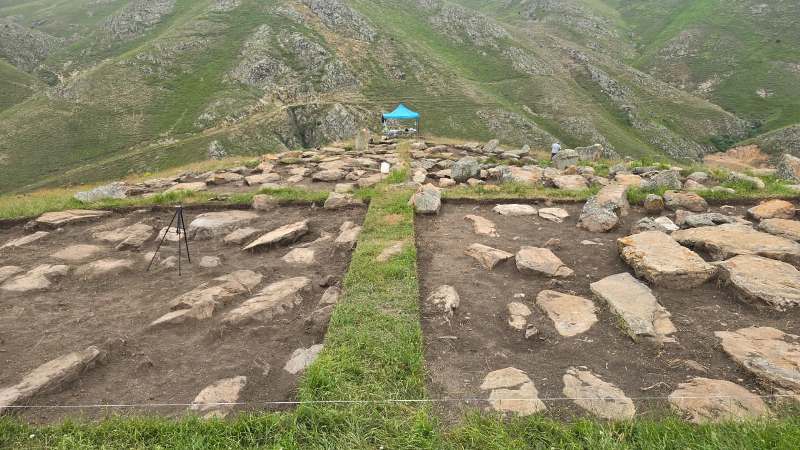
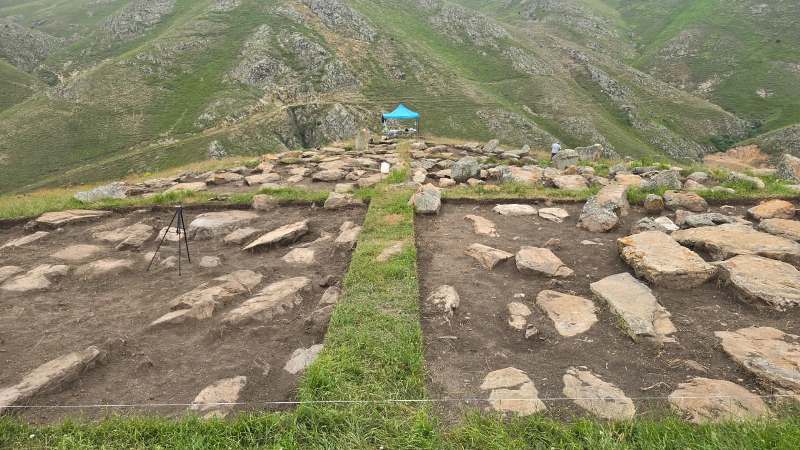
According to Shamil Najafov, the area of the necropolis exceeds 1 hectare. Preliminary observations suggest that the boundaries of the necropolis originally covered a much larger territory. This assumption is supported by the discovery of gravestones of the same type in the surrounding areas, particularly in cultivated fields. In addition, some graves on the eastern edge of the necropolis have been damaged as a result of erosion caused by rainwater and floodwaters washing away the soil on the steep mountain slope. During the initial survey, up to 130 grave monuments with visible surface features were recorded. Some of the graves are marked by upright headstones and footstones, as well as cover stones placed over the burial chambers along a southwest–northeast axis. Graves marked only by cover stones are even more numerous. The graves are densely arranged, and the dimensions of the gravestones vary considerably. The headstones and cover stones are approximately 2–2.5 m long and 50–80 cm thick, with weights ranging from 200–300 kg to 1 tonne. It may be assumed that gravestones of such considerable weight were transported to the cemetery using special methods and used in burial rites.
Before the commencement of archaeological excavations, surveying work was carried out, reference points were established, and the excavation area was divided into excavation zones (A, B, C, D, E) and excavation squares (A1, A2, B1, B2, etc.). Seventeen excavation squares measuring 10 × 10 m, oriented along the north–south axis, were designated, and the initial stage has already been completed in 12 squares within the total excavation area of 1,700 m². In order to determine the exact number of graves and the area they occupy, the topsoil was removed to a depth of 20–40 cm, depending on the relief. The removal of the topsoil revealed a considerable number of previously unknown graves, mainly child burials, bringing the total number of identified graves to nearly 500. This figure demonstrates a substantial increase compared with the graves identified on the basis of surface features and provides a more accurate picture of the burials within the necropolis. Further increases in the number of graves cannot be ruled out once excavation in the remaining squares is completed.
A uniform orientation pattern is observed in the graves of the necropolis. It has been noted that, with only minor deviations, the majority of the graves are aligned southwest–northeast. No traces of carving or processing are visible on the gravestones. The overwhelming majority of the stones are natural fieldstones and mountain stones, while some gravestones are made of granite. The surfaces of only a small number of headstones and cover stones have been roughly smoothed. Albanian crosses, executed mainly by incision, are depicted on such stones. The cross motifs occur in various forms. Crosses carved in the form of a lotus flower with raised edges are particularly common. Although relatively few in number, they are important for identifying Christian symbols of the Albanian period. Owing to their design and distinctive artistic features, Albanian cross-stones represent a harmonious synthesis of the architecture, art, and religious symbolism of the period. Scholarly research on Albanian cross-stones makes it possible to study the history of Albanian Christian monuments from archaeological and architectural perspectives and to shed light on many aspects of early Christianity.
At the next stage, the excavation of the graves, the study of burial customs, and anthropological investigations of the human remains are planned.
Preliminary studies indicate that a small number of burials belong to the pre-Christian period, whereas the majority date to the period following the adoption of Christianity. It may be assumed that burials continued continuously at the necropolis for four to five centuries after the adoption of Christianity.
Archaeological investigations at the necropolis are ongoing.
Translation by Gulhane Aghayeva, Department of Public Relations, Press, and Information, Presidium of ANAS.
© All rights reserved. When using these materials, reference to www.science.gov.az is required.
Similar News


Links