Azerbaijan National Academy of Sciences
The first website of Azerbaijan (1995)
 Elm TV
 Photo
 Video
- A-
- A
- A+
The 2026 Nobel Prizes and Laureates: Global Scientific Priorities and the Tasks Facing Azerbaijani Science
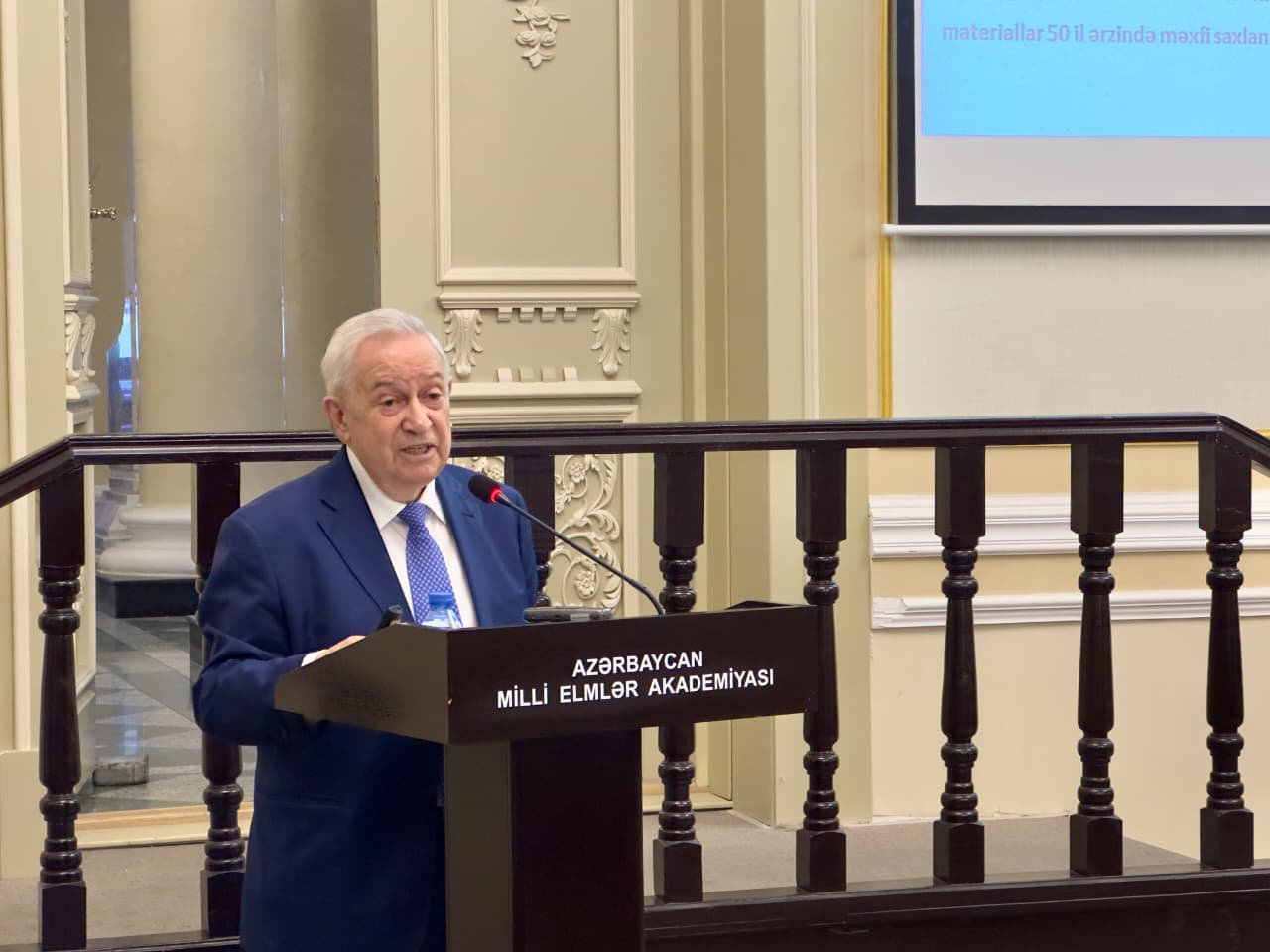
A report entitled “The 2026 Nobel Prizes and Laureates: Global Scientific Priorities and the Tasks Facing Azerbaijani Science” was presented at the next meeting of the Presidium of the Azerbaijan National Academy of Sciences (ANAS).
In his report, Academician Dilgam Taghiyev, Vice-President of ANAS, stated that the laureates of the 2026 Nobel Prizes had been announced. These prizes play a particularly important role in the international recognition of outstanding contributions to the advancement of science and culture, the promotion of peace, and the protection of human rights. According to him, the achievements recognised by these awards once again demonstrate the important role of fundamental scientific research, creative thinking, and universal human values in the development of modern society.
Academician Dilgam Taghiyev noted that the Nobel Prize in Physiology or Medicine had been awarded to Karl Deisseroth, Peter Hegemann, and Georg Nagel for their discoveries concerning light-gated ion channels and optogenetics. Their research paved the way for the development of methods that enable the activity of nerve cells to be controlled using light. These methods have opened up new opportunities for studying brain function and the neural mechanisms underlying memory and behaviour.
He also noted that the Nobel Prize in Physics had been awarded to Francis Halzen for his decisive contributions to the establishment and development of the IceCube Neutrino Observatory and his contributions to the discovery of high-energy neutrinos of astrophysical origin. Located in the Antarctic ice, this observatory enables researchers to investigate high-energy processes occurring in distant regions of the Universe through neutrinos. This research is important for expanding our understanding of the Universe.
Furthermore, he stated that the Nobel Prize in Chemistry had been awarded to Henri B. Kagan and Kenso Soai for their discovery of nonlinear effects and autocatalysis in asymmetric organic synthesis. Their research has made a significant contribution to understanding the mechanisms underlying the formation and selective production of molecular forms that are mirror images of one another.
According to Academician Dilgam Taghiyev, the Nobel Prize in Literature had been awarded to Canadian poet and essayist Anne Carson for works that introduce new forms of expression in contemporary literature through a creative dialogue with the classical literary tradition. In her work, poetry, essays, and translation complement one another, while themes from ancient literature are connected with the experiences of modern people. Her work is noteworthy for its reinterpretation of the classical heritage and its expansion of the expressive possibilities of literary genres.
In 2026, the Nobel Peace Prize was awarded to Navanethem “Navi” Pillay for her efforts to promote peace and international law. Her work in the fields of human rights protection and international justice has highlighted the importance of legal institutions and international cooperation in safeguarding peace.
The report also noted that Robert E. Hall and Michael Woodford had been awarded the Sveriges Riksbank Prize in Economic Sciences in Memory of Alfred Nobel for their research on the microeconomic foundations of macroeconomic stabilisation. Their scholarly work is important for ensuring economic stability, assessing the effects of economic changes, and providing a sound basis for economic policy decisions.
According to the speaker, the 2026 Abel Prize, widely regarded as the Nobel Prize of mathematics, was awarded to Gerd Faltings of Germany for introducing powerful tools in arithmetic geometry and resolving long-standing Diophantine conjectures of Mordell and Lang. The A.M. Turing Award in computer science was awarded to Charles H. Bennett of IBM and Gilles Brassard of Canada for their research establishing the foundations of quantum cryptography and developing principles for secure communication in quantum physics.
In his report, the speaker presented statistics on Nobel Prize laureates for the period 1901–2026. He emphasised that studying the achievements recognised by the Nobel Prizes is important for identifying pressing research challenges in Azerbaijani science, advancing interdisciplinary research, and expanding international scientific cooperation. According to him, organising discussions on this subject helps assess new research opportunities in line with the research profiles of scientific institutions and familiarise young scientists with leading scientific practices.
The report also stated that Azerbaijan ranked 85th among 139 countries in the 2026 Global Innovation Index and 73rd among 236 countries in terms of scientific productivity. In addition, the speaker outlined the main challenges facing global science, fundamental questions that scientists have yet to answer, and other related issues.
Following the discussions, the Presidium of ANAS adopted a relevant resolution.
Translation by Gulhane Aghayeva, Department of Public Relations, Press, and Information, Presidium of ANAS.
© All rights reserved. Reference to www.science.gov.az is required when using materials from this website.
Similar News
Links