Azerbaijan National Academy of Sciences
The first website of Azerbaijan (1995)
 Elm TV
 Photo
Photo
 Video
Video
- A-
- A
- A+
International Conference on “Challenges in Energy, Food, Environment, and Climate Security” Launched in Baku


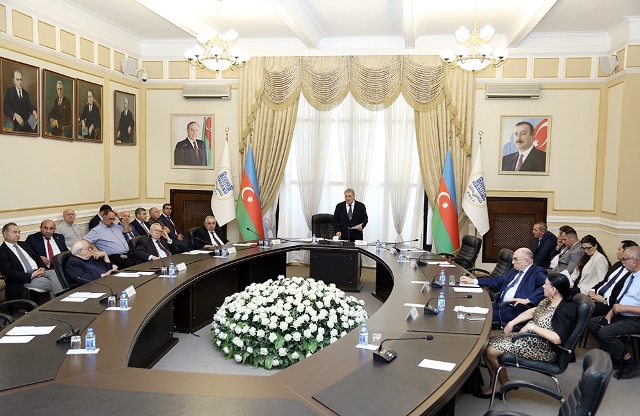
On October 15, the international conference titled “Challenges in Energy, Food, Environment, and Climate Security”commenced its work in Baku.
The event was jointly organized by the Ministry of Science and Education of the Republic of Azerbaijan, the State Agency for Science and Higher Education, and the Institute of Molecular Biology and Biotechnologies.
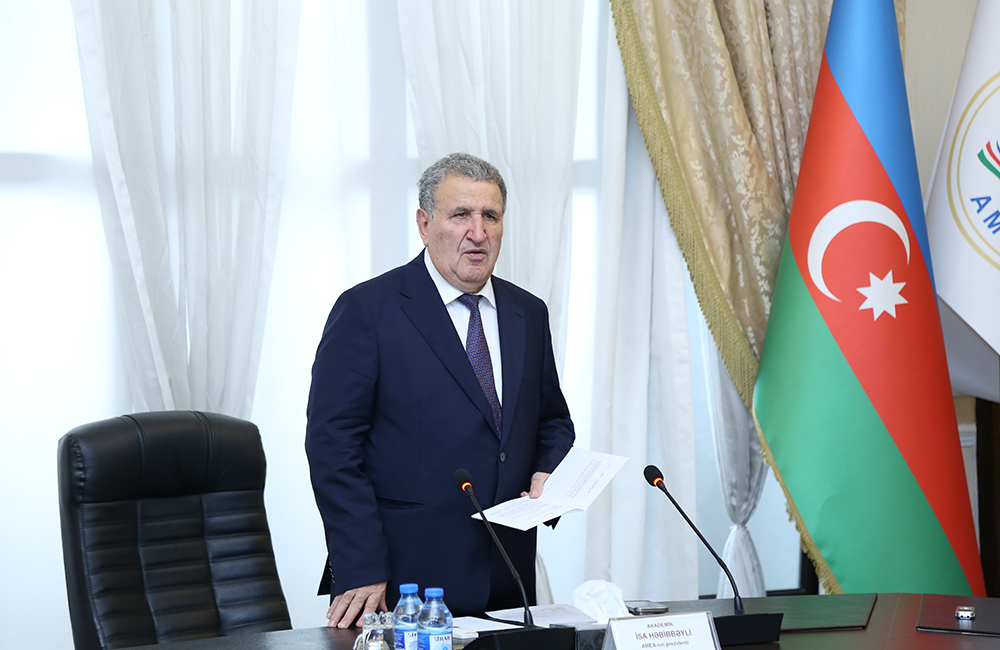
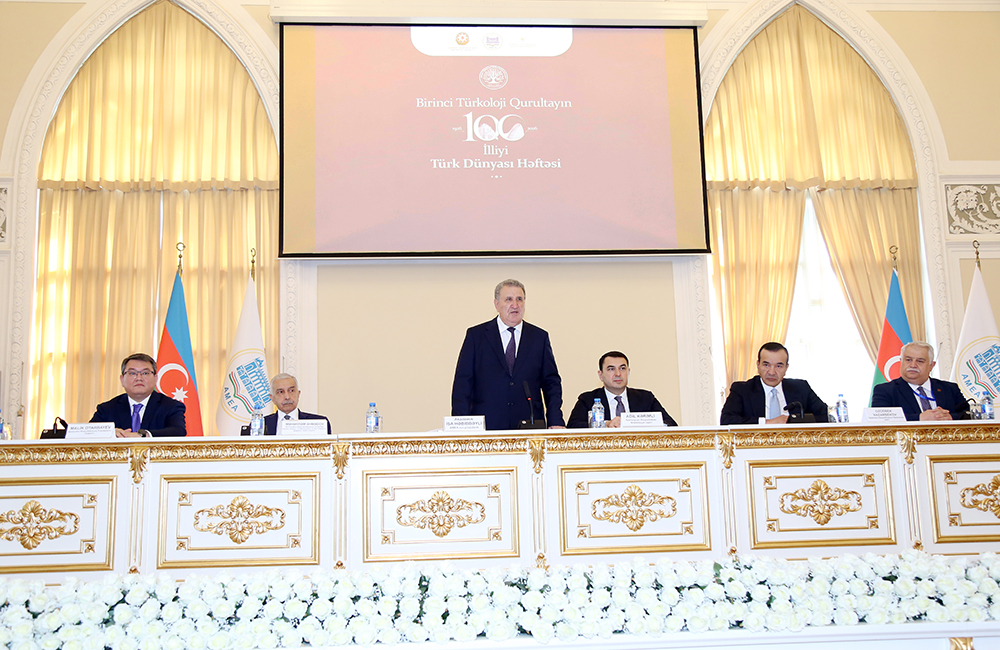
Opening the conference, President of ANAS, academician Isa Habibbayli highlighted the significance of the event, emphasizing that holding such an influential international conference in Azerbaijan was a logical and consistent decision. He noted that the topic of the conference resonates with the key provisions of the United Nations Framework Convention on Climate Change (COP29), which Azerbaijan successfully hosted at a high level last year, and that today’s meeting serves as a continuation of COP29’s ideas and goals within the scientific domain.
Academician Isa Habibbayli stated that hosting such a high-profile event as COP29 under the patronage and with the participation of President Ilham Aliyev was a natural outcome of Azerbaijan’s contribution to the global and regional strategy for transitioning to a green economy, environmental protection, and combating climate change. According to him, COP29 had a notable impact on various aspects of Azerbaijan’s social and economic life, as well as on scientific thought, marking an important milestone in both the country’s and world science history.
“During and after COP29, such notions as ‘green economic zone,’ ‘green energy,’ ‘green technologies,’ and ‘green transformation’ have gone beyond being merely scientific concepts — they have become an expression of our reality,” said Habibbayli, noting that the green energy zones declared by the Head of State in Nakhchivan, Karabakh, and East Zangezur continue their activities successfully.
He emphasized that Azerbaijan is implementing major state programs aimed at developing green energy and ranks among the leading countries not only within the CIS but also globally in the use of alternative energy sources. He added that, along with the country’s internal capabilities, the wide attraction of foreign investments—as part of state policy—contributes to the rapid advancement of this sector. In the near future, Azerbaijan will become an exporter not only of oil and gas but also of alternative energy resources.
According to the ANAS President, the State Program on the Use of Alternative and Renewable Energy Sources, approved by President Ilham Aliyev, will transform Azerbaijan into one of the countries with significant potential in this field.
Habibbayli added that, located at the crossroads of different cultures and continents, Azerbaijan has been conducting not only exploitation, production, and export of diverse energy sources but also scientific research and theoretical studies in these fields. The country has established major scientific schools dedicated to the study of alternative energy sources, ecological issues, and food, environmental, and climate security. Many outstanding scientists have devoted their lives to these spheres, and the research continues to develop dynamically. For more than half a century, scientific institutions under the Ministry of Science and Education have been studying and improving these issues, presenting results to the public as evidence-based Azerbaijani realities.
At the end of his speech, academician Isa Habibbayli expressed confidence that the international conference, attended by over 140 scholars from 14 countries, would contribute to a deeper study of Azerbaijan’s experience, strengthen scientific cooperation, generate joint projects, and inspire new ideas. He wished success to the participants.
Later, Acting Rector of Sumgayit State University, corresponding member of ANAS, Professor Aminağa Sadigov, stated that environmental and climate security are among the most pressing scientific and practical challenges of modern times. He stressed that addressing these issues requires deep interdisciplinary approaches at the global level and that, for this purpose, various scientific platforms and large-scale projects have been established in many developed countries.
Professor Sadigov emphasized that under the leadership of President Ilham Aliyev, Azerbaijan hosts major international events not only in economic, political, and cultural fields but also in science and education. One such example is the “Eurasian University Summit (THE)”, held in Azerbaijan in September this year.
He noted that in recent years, the Ministry of Science and Education has been implementing systemic measures to improve the organizational and academic quality of both international and national-level scientific conferences held in the country. These efforts have significantly increased the prestige and effectiveness of such events.
Professor Sadigov further underlined that, in line with the priorities of state policy, the Ministry implements a comprehensive action plan aimed at sustainable development, efficient use of alternative energy sources, and reducing environmental problems. The Ministry supports scientific research projects, international and national conferences, and other initiatives, while updating educational materials and curricula to integrate the principles of sustainable development into secondary and higher education.
He added that in recent years, the Ministry has funded several projects to stimulate scientific activity and promote research in priority areas. The Ministry also provides financial and institutional support to studies conducted by various scientific institutions, including the Institute of Molecular Biology and Biotechnologies, in strategic fields such as environment, climate change, artificial intelligence, and information technologies.
Professor Sadigov noted that today’s conference serves as an important platform for cooperation between the scientific community, governmental bodies, and private sector representatives. He expressed confidence that the discussions held within the conference will help form new scientific approaches and practical recommendations in the fields of energy, food, environment, and climate security.
Addressing the event, conference co-chair, Azerbaijani scholar and professor at Auburn University (USA), Rashad Karimov, said that the wide scope of the conference topics was no coincidence, as it is impossible to address the listed issues through a single scientific field alone. He emphasized the importance of multidisciplinary research and expressed gratitude to the Ministry of Science and Education, academician Irada Huseynova, and her team for organizing the conference at a high level.
The conference then continued with speeches by Professor Jamal Musayev, Director of the Emerson Center for Scientific Computation at Emory University (USA); Professor Ali Naz from Osnabrück University of Applied Sciences (Germany); Professor Byeong-ha Lee, Head of the Plant Gene Regulation Laboratory at Sogang University (South Korea); Professor Aziz Eftekhari from Ege University (Türkiye); and Professor Shahlo Miralimova, Deputy Director of the Institute of Microbiology of the Academy of Sciences of Uzbekistan. The speakers highlighted the scientific significance of the international conference in fostering discussions on pressing global issues and thanked the organizers for their efforts.
In conclusion, Vice-President of ANAS, Director of the Institute of Molecular Biology and Biotechnologies, academician Irada Huseynova, stated that the main goal of the conference is to develop strategic plans for scientific partnership, determine future research directions, promote innovative solutions supporting the transition to green energy and a clean environment, and generate new scientific ideas that ensure the sustainability of society and the economy.
“The ideas and results presented here will foster international collaboration, the implementation of joint projects, and the creation of regional innovation centers. Science carries not only technological but also moral value. Finding solutions to problems in biological, energy, food, and climate security is the highest scientific mission serving humanity,” she emphasized.
Academician Huseynova also noted that one of the highlights of the conference program is the upcoming ‘Jalal Aliyev Readings’, dedicated to the memory of the distinguished scientist and public figure, academician Jalal Aliyev, which will enhance the academic and moral significance of the event.
She further emphasized that the conference coincides with the 80th anniversary of ANAS, one of the most significant milestones in the history of Azerbaijani science. Celebrating this jubilee at a high level once again confirms the irreplaceable role of ANAS in organizing, managing, and developing science in the country, as well as in forming the national intellectual potential.
Academician Irada Huseynova noted that with the participation of over 140 scholars from 14 countries, this international conference has become an important platform for global scientific cooperation. She stressed that solving problems in green energy, food and nutrition security, bio- and ecological safety, and environmental sustainabilitydepends not only on technology and capital but also on knowledge and scientific integration:
“If we aim to confidently move toward a green future, it is essential that scientists, engineers, and experts in agricultural and biomedical sciences working in multidisciplinary teams unite under a single scientific platform.”
The Vice-President added that research conducted worldwide shows that artificial intelligence, machine learning, bioinformatics, synthetic biology, and nanotechnologies are increasingly playing a key role in ensuring energy, food, and climate stability.
Speaking about Azerbaijan’s recent scientific and practical achievements in bioeconomy, green technologies, and biotechnology — supported by state initiatives — academician Huseynova stated that the ‘Green Zone Model’ being developed in Karabakh and East Zangezur has attracted international attention as a unique approach to ensuring energy and environmental security. Currently, new AI-based methodological approaches are being developed nationwide in agro-biotechnology, land and water resource management, and climate modeling.
Expressing confidence that the conference will become an important milestone for the exchange of scientific ideas, new partnerships, and sustainable development, academician Irada Huseynova wished all participants productive discussions and further scientific success.
The conference continued its work with a plenary session and thematic panels.
It should be noted that the international conference will conclude on October 17.
Translation: Gulhane Aghayeva, Department of Public Relations, Press and Information of the Presidium of ANAS
© All rights reserved. Reference to www.science.gov.az is required when using the materials.
Similar News
Links