Azerbaijan National Academy of Sciences
The first website of Azerbaijan (1995)
 Elm TV
 Photo
Photo
 Video
Video
- A-
- A
- A+
Annual Report of the Academy Presented at ANAS General Assembly
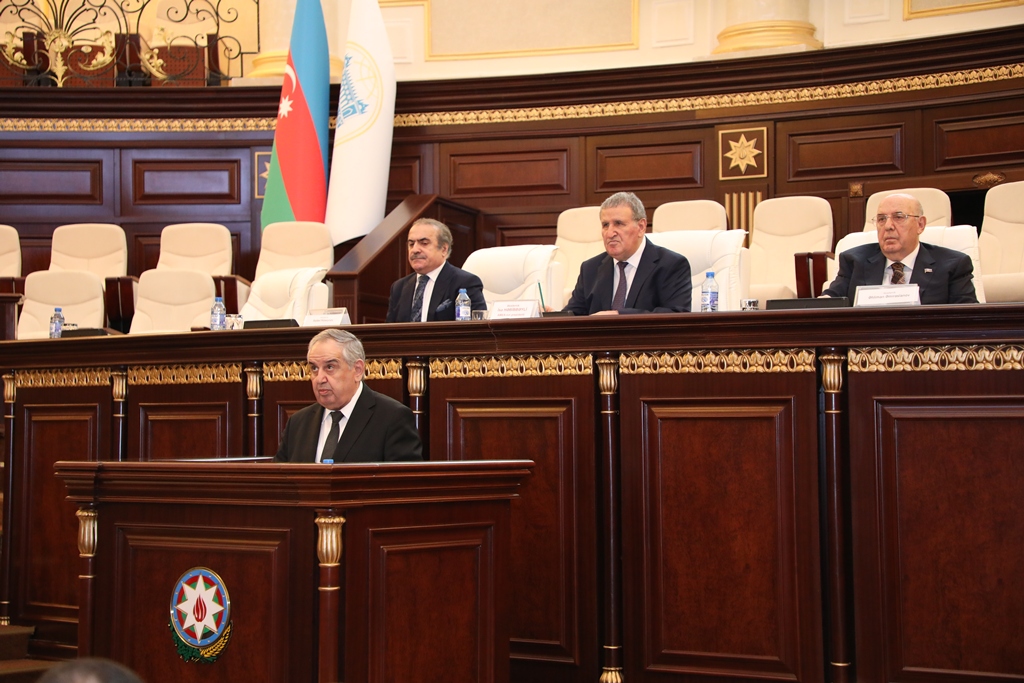
At the General Assembly of the Azerbaijan National Academy of Sciences (ANAS), the Academy’s annual report dedicated to the results of 2025 was presented. The report was delivered by ANAS Academic Secretary, Academician Arif Hashimov, who noted that it had been prepared in accordance with the ANAS Charter and covered the Academy’s scientific, organizational, and international activities during the reporting period.
Academician Arif Hashimov stated that during the reporting year, ANAS organized its activities based on decrees and orders signed by President of the Republic of Azerbaijan Ilham Aliyev, and adopted the Head of State’s тезис that “COP29 is a turning point in climate diplomacy” as a new priority for science. Consistent measures were implemented to fulfill the tasks arising from the decisions of the General Assembly and the Presidium of the Academy.
The Academic Secretary described President Ilham Aliyev’s Order “On the Celebration of the 80th Anniversary of the Azerbaijan National Academy of Sciences” and his participation in the anniversary event held on November 3, 2025 as a clear example of the attention given to Azerbaijani science.
Academician Arif Hashimov noted that the scientometric indicators presented for the reporting period confirm the sustainable development of scientific research compared to previous years.
The report highlighted significant scientific results and the fundamental and applied research conducted within ANAS across its Divisions of Humanities, Social Sciences, Chemical Sciences, Biological and Medical Sciences, Physical-Mathematical and Technical Sciences, and Earth Sciences.
Speaking about the Division of Humanities, Academician Arif Hashimov outlined the main scientific achievements of 2025. He stated that research was carried out on classical and modern Azerbaijani literature, as well as in Turkology and cultural studies, and that new scientific approaches were developed in the fields of literature and music.
Within the Division of Social Sciences, attention was drawn to research conducted in history, philosophy, and archaeology. Studies related to the state of Atropatena, scientific findings on religious and ethnic topics, and archaeological research carried out within the framework of international cooperation were reflected in the report.
In the Division of Chemical Sciences, fundamental results in molecular electronics and materials science were emphasized, along with the production of the inhibitor-bactericide “Parkorin-22A,” applied in the oil industry.
Under the Division of Biological and Medical Sciences, research on drought-resistant plant genotypes and findings from international collaborative studies on breast cancer were presented.
The Division of Physical-Mathematical and Technical Sciences reported on research conducted in radiation safety, environmental issues, artificial intelligence, big data analytics, digital government, information security, and space and nuclear studies.
Within the Division of Earth Sciences, the creation of the “Digital Caspian” interactive database, research on changes in wind regimes in the Caspian Sea, and results achieved in assessing the country’s water resources were highlighted. The report also presented specific figures on Azerbaijan’s water resource supply indicators.
Scientometric indicators for each division were also presented to participants of the event.
In addition, information was provided on the activities of the Republican Seismological Service Center, the Nakhchivan and Ganja branches, the Sheki and Lankaran Regional Scientific Centers, the results of archaeological and historical research, measures implemented within the “Azerbaijan National Encyclopedia,” as well as the work carried out in library and publishing activities at the ANAS Central Scientific Library and ANAS “Elm” Publishing House. Editorial processes related to the “Azerbaijan National Encyclopedia” and the “Heydar Aliyev Encyclopedia” were also addressed.
The speaker also informed participants about activities undertaken within the framework of international scientific cooperation, noting that ANAS signed nearly 30 cooperation agreements in 2025 and was represented at the General Assembly meeting of the Association of Academies and Societies of Sciences in Asia.
The academician further emphasized that the Digital Academy, the Artificial Intelligence and Electronic Services Department developed a model aimed at creating a “gold standard” to increase the accuracy of Azerbaijani language processing by artificial intelligence.
Academician Arif Hashimov described as notable events of the reporting period the establishment, on the occasion of ANAS’s 80th anniversary, of the “ANAS Badge of Honor” as well as the “Aziz Sancar,” “Yusif Mammadaliyev,” “Uzeyir Hajibeyli,” and “Lev Landau” badges; the holding of anniversary events in Ankara, Türkiye, at Baku State University, Karabakh University, and a number of other universities and organizations; the election of Academician Isa Habibbeyli as an honorary member of the Turkish Academy of Sciences; and the establishment of the “Youth Academy” on the basis of the Academy’s Council of Young Scientists and Specialists.
In conclusion, the ANAS Academic Secretary stated that, overall, the research conducted in 2025 and the significant scientific results achieved at the scientific institutions of the Azerbaijan National Academy of Sciences and at other scientific and higher education institutions of the republic within its areas of activity can be highly appreciated.
Translation by Gulhane Aghayeva, Department of Public Relations, Press, and Information, Presidium of ANAS.
© All rights reserved. Reference to www.science.gov.az is required when using materials from this site.
Similar News
Links