Azerbaijan National Academy of Sciences
The first website of Azerbaijan (1995)
 Elm TV
 Photo
Photo
 Video
Video
- A-
- A
- A+
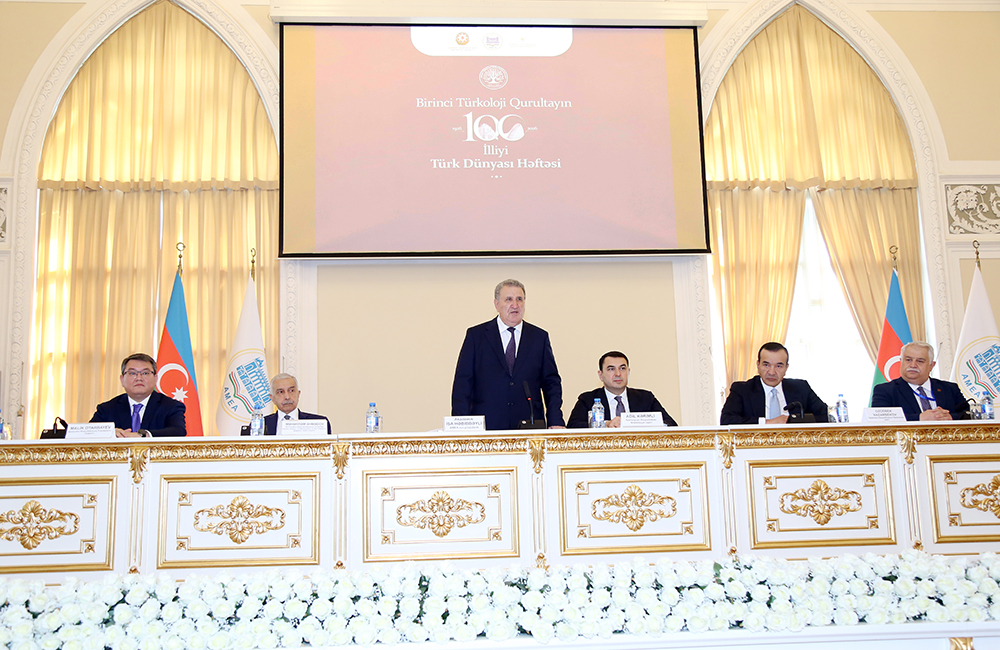
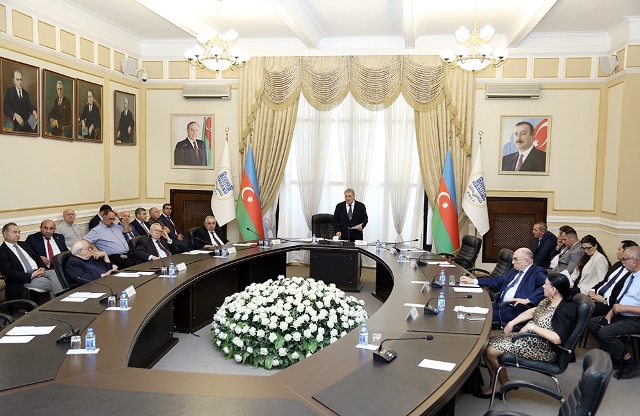
The 1st International Symposium on Traditional Music and Cultural Identity of the Turkic World Has Opened


The 1st International Symposium on Traditional Music and Cultural Identity of the Turkic World, dedicated to the 150th anniversary of Kalvalı Ali Dədə, has opened at the Central Scientific Library of ANAS.
The event was jointly organized by the Institute of Folklore of ANAS, the Institute of Architecture and Art, the Azerbaijan National Conservatory, Ankara University of Music and Fine Arts, Erzincan Binali Yıldırım University, Kars Kafkas University State Conservatory, Khoja Akhmet Yassawi International Kazakh-Turkish University, the Azerbaijan Ashiqs Union, and the International Mugham Center of Azerbaijan.
First, fresh flowers were laid at the bust of National Leader Heydar Aliyev in the foyer of the library, and the cherished memory of the great leader was honored with respect.
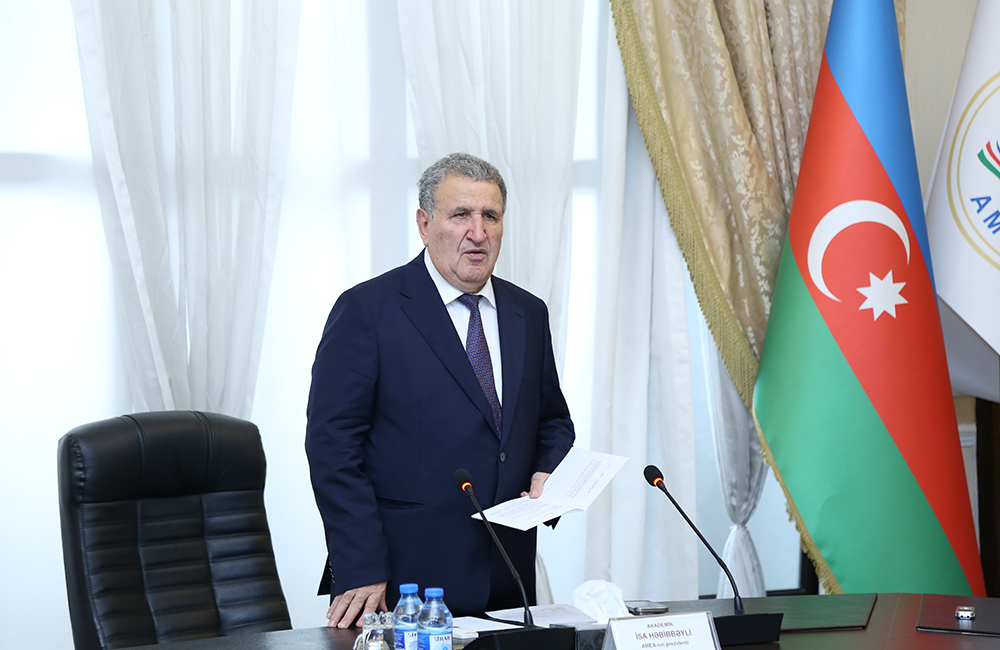
Opening the event with a welcome speech, ANAS President, Academician Isa Habibbayli, stated that the main purpose of the symposium is to explore, on an academic basis, the rich musical folklore of the Turkic world, particularly the historical roots, cultural identity, and traces in collective memory of ancient musical instruments such as the balaban, zurna, and saz. He also noted the scholarly importance of examining the artistic legacy of Ali Karimov, known as Kalvalı Ali Dədə, a prominent representative of the zurna-balaban school, in the context of the Turkic world.
The ANAS President emphasized that the ideas voiced by President Ilham Aliyev at the 80th anniversary of ANAS set new strategic tasks for the scientific community. According to him, preserving national and moral values, strengthening the concept of Azerbaijani identity, and presenting cultural heritage to society require the scholarly study and promotion of the legacy of artistic masters. Academician Isa Habibbayli noted that although many scientific events are held in the field of folklore, projects dedicated to the legacy of folk artists and traditional performers remain limited, and there is a need for broader promotion of instruments such as the garmon, zurna, balaban, and gaval.
He recalled that Kalvalı Ali Dədə was a master performer of wind instruments such as the zurna, balaban, and tütek, and that he created a major school as the author of more than 70 dance tunes. He added that his art is still preserved today by both his successors and family members. Academician Isa Habibbayli noted that this symposium, dedicated to the 150th anniversary of the master artist, is an expression of the scientific community’s respect for his legacy and an important event promoting ancient wind instruments. He emphasized that the presentations to be delivered at the event hold particular historical significance as the first fundamental academic research in this field in the country and open new perspectives for the systematic study of traditional performance heritage.
Concluding his remarks, the ANAS President wished success to the symposium participants and stressed the importance of continuing research in this area.
Then, the Chief of Staff of the Turkic Culture and Heritage Foundation, Doctor of Historical Sciences Fakhri Hajiyev, read the message addressed to the event by the Foundation’s President, Ms. Aktoty Raimkulova.
He noted the significance of the symposium in studying the shared spiritual memory of Turkic peoples. He stated that traditional music is not merely an art form for Turkic-speaking peoples but a fundamental value that preserves identity, connects generations, and ensures cultural continuity. He emphasized that national traditions such as mugham, ashiq art, and folk melodies resonate with similar musical codes found across different regions of the Turkic world, which is a strong indicator of shared cultural roots.
“The main mission of the Turkic Culture and Heritage Foundation is the study, preservation, and international promotion of the rich cultural heritage of the Turkic World,” Fakhri Hajiyev stated. He highlighted that the study, digitalization, archiving, and transmission of the musical heritage of Turkic peoples to younger generations are among the Foundation’s priority areas.
Fakhri Hajiyev also spoke about the cooperation carried out between the Institute of Folklore and the Turkic Culture and Heritage Foundation over the past year, provided information on joint projects underway, and highly appreciated the collaboration.
Finally, the Chief of Staff of the Foundation expressed gratitude to the organizers of the event and stated his confidence that the symposium would open new opportunities for expanding cooperation among scholars of the Turkic world and strengthening cultural unity.
Rector of the Azerbaijan National Conservatory, Professor Kamila Dadash-zade, noted in her remarks that the symposium creates an important platform for the cultural integration of Turkic peoples, the environment of scientific cooperation, and unity around shared cultural values.
Kamila Dadash-zade stated that the main goal of the symposium is to summarize research conducted in the field of traditional music of Turkic-speaking peoples and to strengthen scholarly exchange. She emphasized that in the modern era, the study of traditional music as an important indicator of ethnic identity based on academic paradigms is particularly relevant, and the symposium provides an opportunity to clarify theoretical and practical approaches in this field.
The Rector emphasized that today’s symposium contributes significantly to the development of cultural integration in the Turkic world, the preservation of shared musical memory, and the formation of new academic collaborations.
Speaking at the event, Vice-Rector of the Azerbaijan State Pedagogical University, Professor Mahira Huseynova, touched upon the importance of introducing the legacy of Kalvalı Ali Dədə to younger generations. She noted that being a “kalvalı” 150 years ago required great artistry, deep moral values, and mastery. She emphasized that such symposiums are extremely important for studying national memory, musical thought, and folklore heritage.
She said that the title “dədə” is not given to every artist and requires profound moral responsibility, tradition, and artistic depth. She highly valued the commemoration and study of Kalvalı Ali Dədə’s rich legacy and artistic works at such a scale.
Professor Mahira Huseynova stressed that national musical instruments—the saz, ney, balaban, and zurna—are inseparable elements of the spiritual identity of the Azerbaijani people. She noted that the plaintive sound of the ney, which conveys the sorrows of the Karabakh war and the pain of martyr mothers, holds a special place in the nation’s memory: “Music is as valuable and meaningful as words. Music speaks what a person cannot express.”
Professor Mahira Huseynova expressed confidence that the symposium would leave a deep impression on the participants and young researchers and stimulate the formation of new academic directions in this field.
Then, Rector of Ankara University of Music and Fine Arts, Professor Erhan Özden, noted that Turkic art and traditional music have played an important role throughout history in identity building and cultural stability. He stated that music is not merely an art field for Turkic peoples but an important heritage preserving pan-Turkic cultural codes.
Professor Erhan Özden added that the presence of shared musical sensibilities among Turkic communities spread across various geographic regions and the reflection of “Turkic consciousness” in music has significantly contributed to the preservation of cultural unity. He emphasized that systematic study and preservation of this heritage are of strategic importance for the entire Turkic world.
Erhan Özden stated that the symposium creates an opportunity for scholarly discussion of the musical heritage of Turkic peoples and opens new perspectives for future research.
Director of the Institute of Architecture and Art of ANAS, Corresponding Member of ANAS, Ertegin Salamzade, spoke about the formation of cultural identity in the Turkic world and the role of music. He noted that music is not only a part of art but also one of the main indicators of an ethnos’s self-awareness, differentiation, and preservation of cultural characteristics.
The scholar stated that cultural identity in the Turkic world is formed both at the level of individual peoples and within the framework of a common Turkic identity. Professor Ertegin Salamzade emphasized that large states created by ancient Turks and the factor of a shared language lie at the root of pan-Turkic identity.
He noted that modern Turkology is no longer limited to linguistics but now encompasses folklore, art, architecture, ethnography, and other humanitarian fields. The Director emphasized the formation of a new scholarly direction—Turkological art studies—which allows for the integrated study of Turkic culture, and noted that traditional music is an important component of this vast cultural heritage.
Director of the Institute of Folklore of ANAS, Doctor of Philology Hikmat Guliyev, stated that the event is of great importance for the scholarly study of the shared musical memory, traditions, and performance heritage of the Turkic world. According to him, the symposium brings together researchers from Azerbaijan, Türkiye, Uzbekistan, Kazakhstan, and Kyrgyzstan to discuss issues such as the word–music–movement triad, traditional performance, and the relationship between folklore and music, and provides an important academic platform for the preservation of national identity in the era of modern globalization.
In his speech, Hikmat Guliyev stated that Kalvalı Ali Dədə is one of the key archetypes of Azerbaijan’s wind music in collective memory and emphasized the importance of studying and promoting this legacy. He noted that preparing academically grounded arguments in the context of falsification and appropriation attempts related to national instruments such as the zurna, balaban, tar, and kamancha is a matter of national responsibility.
The Director also stressed the necessity of comparative study of the musical codes of the Turkic world and the formation of a shared academic discourse. He noted that developing a unified academic concept for Turkic music and creating a digital archive of Kalvalı Ali Dədə’s legacy are among important future academic directions.
At the event, Associate Professor Jasurbek Salayev, Director of the Khorezm Regional Center for Pedagogical Skills of Uzbekistan, stated that Uzbekistan participates in the event with a large delegation. He emphasized that the country is represented at the symposium by a 28-member delegation, which reflects Uzbekistan’s high regard for academic and cultural cooperation with the Turkic world.
Associate Professor Jasurbek Salayev stated that the symposium is an important platform for strengthening ties among Turkic peoples, studying traditional musical heritage, and expanding academic exchange. He emphasized that such events hold special significance for preserving shared cultural values and transmitting them to future generations.
Finally, on behalf of the family of Kalvalı Ali Dədə, Associate Professor Elchin Galiboglu, Senior Researcher at the Institute of Folklore, expressed gratitude to the organizers and participants for valuing the master artist’s legacy. He noted that ancient musical instruments such as the zurna and balaban fully convey the universal content inherited from the Turkic world. According to him, well-known melodies composed by Kalvalı Ali Dədə such as “Heyvagülü”, “Alma gülü”, “Alça gülü”, “Bənövşə”, “Kalvalı”, “Çəmənlik”, “Mehribanı”, “Dağ çiçəyi”, and “Xırdaca” serve as major examples not only for performers of zurna and balaban today but also for followers of ashiq art.
The event then continued with an artistic segment.
After the artistic segment, plenary presentations on various topics were heard and discussions were held.
It should be noted that the international symposium will conclude on November 21, 2025.
Translation by Gulhane Aghayeva, Department of Public Relations, Press, and Information, Presidium of ANAS.
© All rights reserved. Reference to www.science.gov.az is required when using materials from this site.
Similar News
Links